Mannitol salt agar or MSA is a commonly used selective and differential growth medium in microbiology. It encourages the growth of a group of certain bacteria while inhibiting the growth of others. This medium is important in medical laboratories as one method of distinguishing pathogenic microbes in a short period of time.[1] It contains a high concentration (about 7.5–10%) of salt (NaCl) which is inhibitory to most bacteria - making MSA selective against most Gram-negative and selective for some Gram-positive bacteria (Staphylococcus, Enterococcus and Micrococcaceae) that tolerate high salt concentrations.[2] It is also a differential medium for mannitol-fermenting staphylococci, containing carbohydrate mannitol and the indicator phenol red, a pH indicator for detecting acid produced by mannitol-fermenting staphylococci.[3] Staphylococcus aureus produces yellow colonies with yellow zones, whereas other coagulase-negative staphylococci produce small pink or red colonies with no colour change to the medium.[4] If an organism can ferment mannitol, an acidic byproduct is formed that causes the phenol red in the agar to turn yellow.[1] It is used for the selective isolation of presumptive pathogenic (pp) Staphylococcus species.[5]
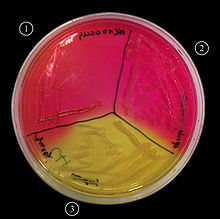
Expected results
- Gram + Staphylococcus: fermenting mannitol: medium turns yellow (e.g. S. aureus)
- Gram + Staphylococcus: not fermenting mannitol, medium does not change color (e.g. S. epidermidis)
- Gram + Streptococcus: inhibited growth
- Gram -: inhibited growth[1]
Typical composition
MSA typically contains:[6]
- 5.0 g/L enzymatic digest of casein
- 5.0 g/L enzymatic digest of animal tissue
- 1.0 g/L beef extract
- 10.0 g/L D-mannitol
- 75.0 g/L sodium chloride
- 0.025 g/L phenol red
- 15.0 g/L agar
- pH 7.4 ± 0.2 at 25 °C
| This article uses material from the Wikipedia article Metasyntactic variable, which is released under the Creative Commons Attribution-ShareAlike 3.0 Unported License. |